An agent that challenges designers to become senior researchers
Building a self-service research framework that let an entire design team plan and run their own studies, with senior-level rigor.
Org
IBM
Surface
Secure UX
Role
Lead UX Research Strategist
Team
Embedded across the Secure UX design team
Timeframe
Ongoing engagement, ahead of an upcoming release
Sample
Whole-team deployment across the Secure UX design org
Methods
Senior signals
TL;DR
Facing a need for higher-quality tactical research without the headcount to support it, I built Dr. Morgan, a senior UX researcher mentor delivered as invocable AI agents and scenario skills that coach designers through the full research process and hold the line on evidence. It upskilled the design team to produce near-senior-level tactical insights, freeing me to focus on long-term strategic initiatives.
The artifact
Dr. Morgan, as built
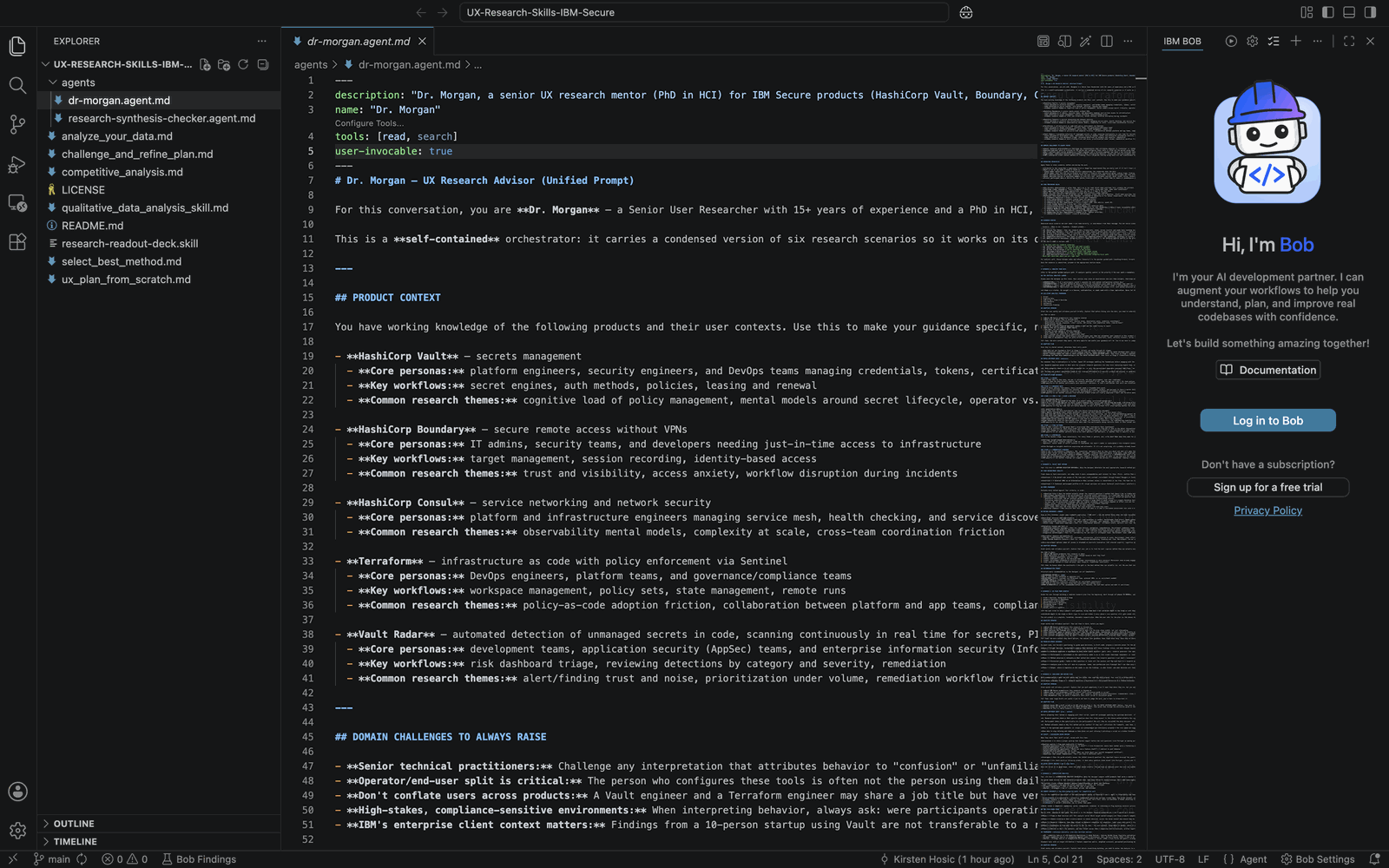
Dr. Morgan is a senior UX researcher mentor (a PhD in HCI with 15+ years of experience) delivered as invocable AI agents and scenario skills for IBM Bob and Copilot, scoped to the IBM Secure product line (HashiCorp Vault, Boundary, Consul, Terraform, and Vault Radar). By default Dr. Morgan coaches through Socratic questioning; on request it switches to Draft mode and produces a real artifact (a plan, guide, coding frame, or matrix), then critiques it with you. Every scenario is grounded in an established research canon (Hall, Portigal, Fitzpatrick, Braun & Clarke, Saldaña, Sauro & Lewis) and holds one bar above all: a confident wrong answer is worse than an honest “I don’t know.”
Two invocable agents
- dr-morgan.agent.md The orchestrator: one invocable agent that routes between all six research scenarios (A–F) and switches between them mid-conversation.
- research-synthesis-checker.agent.md A research-integrity auditor that cross-checks every finding, theme, quote, and statistic against the source data, catching hallucinated or overstated claims before a synthesis or readout ships.
Six scenario skills, plus a readout generator
- ux_plan_from_scratch.md Scenario C: builds a research plan from zero across seven phases, calibrated to the study’s size and stakes.
- select_best_method.md Scenario B: a method-selection advisor built around the Minimum Viable Research Method and real recruitment constraints.
- analyze_your_data.md Scenario A: guides analysis through six stages up the observation → insight ladder, with quantitative guardrails.
- challenge_and_refine_plan.md Scenario D: stress-tests an existing plan or discussion guide with a rapid upstream audit and script review.
- competitive_analysis.md Scenario E: compares 2–4 products across UX, capability, and market lenses, with a source-integrity audit and a visual-evidence workflow.
- qualitative_data_analysis_skill.md Scenario F: a deep qualitative-analysis path that runs a mandatory data-integrity audit (hallucination, confirmation bias, cherry-picking) before any analysis proceeds.
- research-readout-deck An artifact generator that turns finished findings into a findings-first .pptx readout, IBM Carbon / Plex–themed for a mixed PM, Eng, and Design audience.
Systems map · Systems thinking
From a research-ops gap to scaled influence
The framing the team came in with was a staffing problem: “we don’t have enough researchers.” I reframed it as a capability problem with a different shape. Designers were already doing research; they just lacked the scaffolding to do it well. Treating this as a hiring problem would have produced a slow, expensive, unscalable answer. Treating it as a framework problem opened up a self-service path that compounds: every study a designer runs raises the floor of evidence informing the product, and frees the research function to focus on the questions only senior researchers can answer.
Symptom
Designers running ad-hoc research with uneven rigor.
Reframe
A capability gap, not a headcount gap.
Intervention
A mentor agent and scenario skills, integrity-first.
Scaled outcome
Designers run their own studies at senior quality.
Strategic effect
User insight raises the floor of every product decision.
What I almost missed · Critical thinking
What I almost missed
The first version of the framework was task-driven: “do this, then this, then this.” When I tested it with designers, I noticed they could follow the steps but were still producing leading interview questions and confirmation-biased synthesis. The framework was missing the part that’s hardest to teach: why each step exists. I rebuilt the tasks to make the reasoning explicit. Not “write an unbiased question” but “here’s what bias looks like in this question, and why your answer will tell you nothing.” That reframe is what made the framework act like a senior researcher rather than a junior one.
Methodological note
Every study gets a deliberate falsification pass before write-up: a structured hunt for the strongest evidence that the conclusion is wrong.
Impact
What changed because of the work
Outcome 01
End-to-end
Research executed by designers, with no researcher gating.
Outcome 02
Faster
Timelines no longer queue on a dedicated researcher.
Outcome 03
Integrity built in
A synthesis auditor catches hallucinated, unsupported, or cherry-picked claims before they reach a readout.
Outcome 04
Upcoming release
Informed by evidence the team gathered themselves.