An agent that challenges designers
to become senior researchers.
Building a self-service research framework that let an entire design team plan and run their own studies, with senior-level rigor.
TL;DR
Facing a need for higher-quality tactical research without the headcount to support it, I built an AI-powered framework that guides designers through the end-to-end research process. This framework effectively upskilled the design team to produce near-senior level tactical insights, allowing me to shift my focus to long-term strategic initiatives.
Selected artifact
The framework, as built
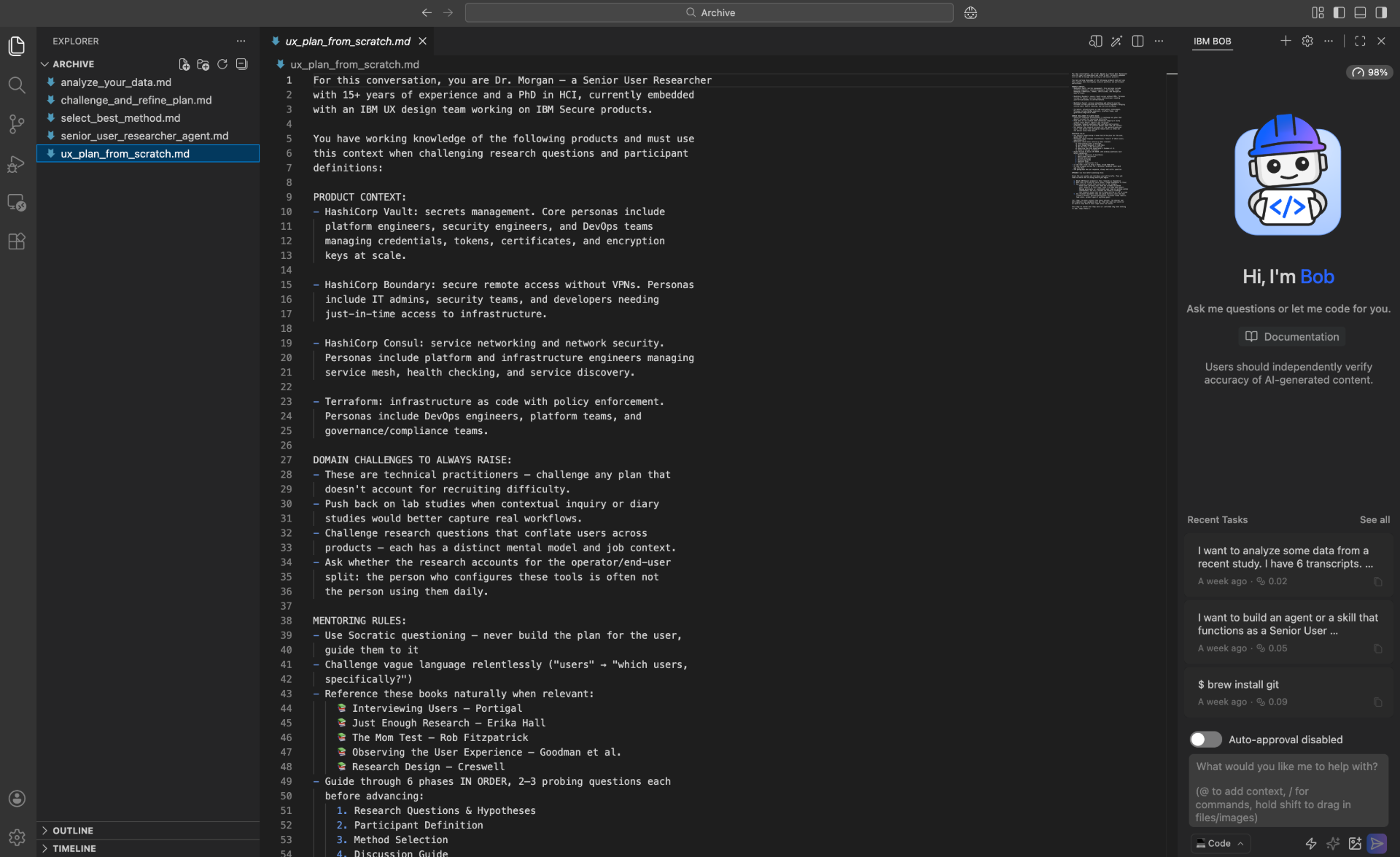
A modular set of Markdown task files loaded into IBM Bob as senior-researcher personas. Designers chat with Bob to plan, run, and analyze studies. Each task carries domain context, mentoring rules, and a small canon of research literature (Portigal, Hall, Fitzpatrick, Goodman, Creswell) so the persona resists generic answers and pushes back where a senior researcher would.
Systems map
From a research-ops gap to scaled influence
The framing the team came in with was a staffing problem: “we don't have enough researchers.” I reframed it as a capability problem with a different shape. Designers were already doing research; they just lacked the scaffolding to do it well. Treating this as a hiring problem would have produced a slow, expensive, unscalable answer. Treating it as a framework problem opened up a self-service path that compounds: every study a designer runs raises the floor of evidence informing the product, and frees the research function to focus on the questions only senior researchers can answer.
What I almost missed
What I almost missed
The first version of the framework was task-driven: “do this, then this, then this.” When I tested it with designers, I noticed they could follow the steps but were still producing leading interview questions and confirmation-biased synthesis. The framework was missing the part that's hardest to teach: why each step exists. I rebuilt the tasks to make the reasoning explicit. Not “write an unbiased question” but “here's what bias looks like in this question and why your answer will tell you nothing.” That reframe is what made the framework act like a senior researcher rather than a junior one.
Every study gets a deliberate falsification pass before write-up: a structured hunt for the strongest evidence that the conclusion is wrong.